

Clear and Effective EdTech Policy: Why the Purpose Statement Is the Hardest Part to Get Right
Part 2 of 6 in a series on the Safe & Purposeful EdTech Pledge

Check out Part 1 here.
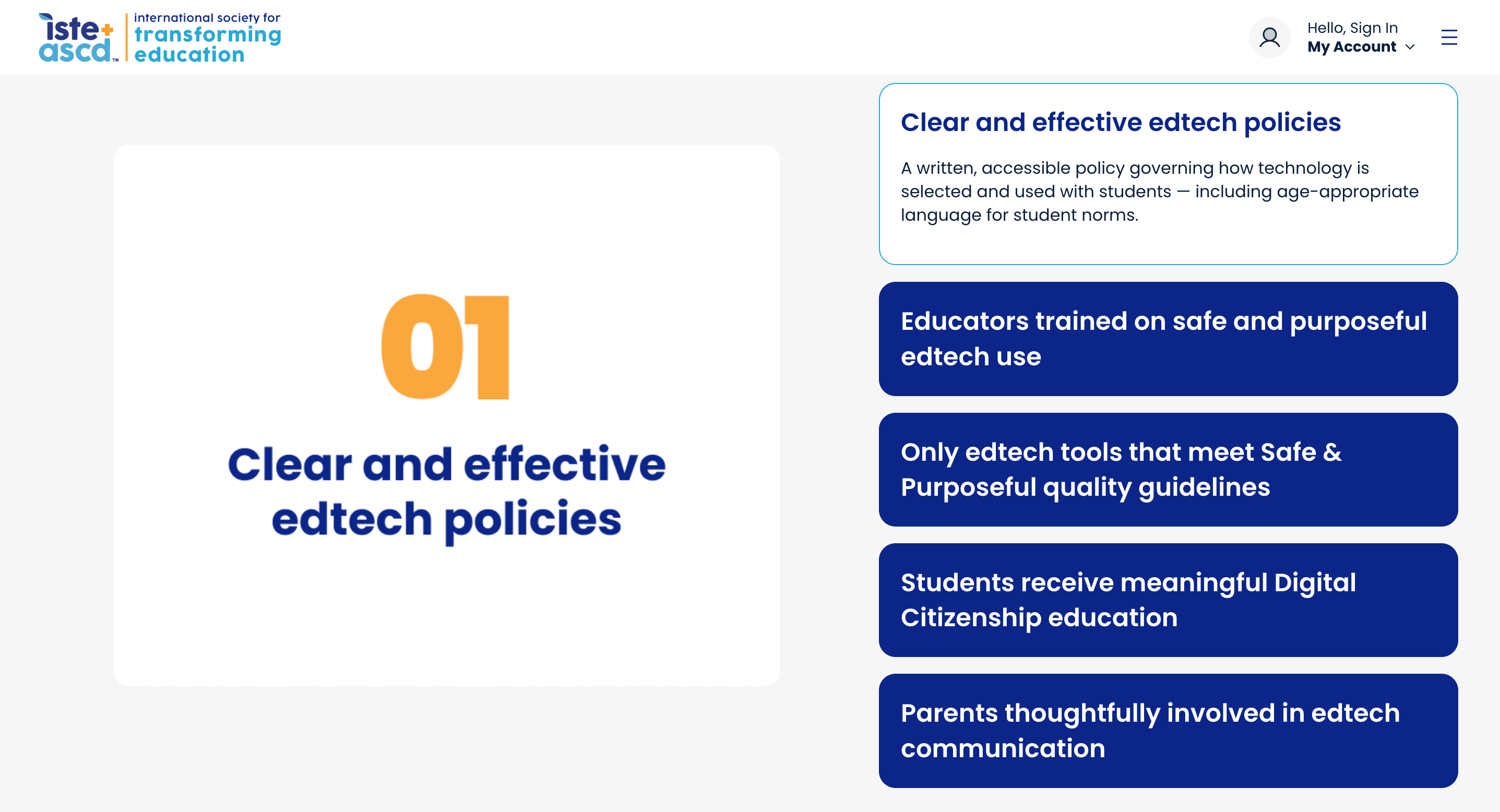
The first commitment in the Safe & Purposeful EdTech Pledge asks schools to maintain “a written, accessible policy governing how technology is selected and used with students — including age-appropriate language for student norms.” If conversations about technology policies are new to you, a coalition of organizations including CoSN, the Digital Citizenship Coalition, ISTE, and ATLIS created their own guide, Setting Conditions for Success: Creating Effective Responsible Use Policies for Schools. This is a strong explainer on what Acceptable Use Policies and Responsible Use Agreements could include. The guide walks through what an effective policy contains and what to avoid, offers examples of policies gone wrong, and provides sample templates for both elementary and secondary schools.
I know some of your eyes have already glazed over. Maybe because you saw that the topic is policy and the mere idea of policy bores you. Or perhaps your school or organization already has a technology policy…why not just leave it as it is?
Stick with me.
Why this matters
The question I keep coming back to is why policy is the first commitment in this pledge, ahead of training, procurement, curriculum, and communication? It seems like this is the wrong way around, particularly considering the professional development piece. How can you have a policy about something that educators haven’t yet learned about?
After reflecting, I do not think the ordering is an accident when we focus on the first step of writing a policy: defining the purpose. Of course, the purpose statement is just one component of a finished policy, but it is where we must start. Education organizations cannot support educators on safe and purposeful use if there is no written, agreed-upon, and compelling definition of what purposeful actually means. Similarly, you can’t pick tools to invest in if the purpose of those tools is yet to be defined. The purpose statement should drive everything, which means it is really important to get it right.
What makes this harder than it sounds
As I just established, a great deal rests on writing a high quality purpose statement. A watertight purpose statement is what keeps a school out of trouble later, when a parent or a school board member asks why technology is being used a certain way, and the answer needs to hold up.
The guide I pointed you to above opens its elementary template with a purpose statement worth examining closely. It states that the school uses technology to “make learning more engaging and help students be more curious and creative learners.” I want you to pause and analyze that purpose statement. Is it watertight? Does that point to the best uses of technology in classrooms?
Consider this from a few different perspectives. Here is what I think a tech-skeptical parent, an overly tech-enthusiastic parent, and an educator might say if you handed them this line.
A skeptical parent would point out that “engaging” is a vague and sometimes misleading EdTech buzzword. No one would disagree that we want students engaged in learning. But, when software relies on time-based competition, meaningless points, and other features to “engage” students, learning suffers.
An overly enthusiastic parent might read the same sentence and ask the school to give more, unstructured technology time for students to explore their interests. Unlimited curiosity and intellectual exploration are great in theory, but in practice, this quickly devolves into a chaotic gumbo of irrelevant YouTube videos and gaming.
An educator would ask a more practical question: does this sentence guide me on when to reach for a device, and when to put it away? It does not give a family a reason to trust that the school has thought critically about the difference between technology that helps students learn and technology that simply keeps them occupied, and it gives a teacher no actual basis for setting aside a tool that is popular but not effective.
There are many reasons why schools have adopted technology, but that does not mean all of those reasons are created equal, or that all of them are actually related to the purposeful and safe use of technology in classrooms. A technology policy purpose statement should emphasize that technology is used when it enhances learning in a meaningful way, that educators will leverage safe and vetted tools, and that this will be communicated clearly to all students.
If I were leading a workshop
Writing a good policy is best done collaboratively with various stakeholders’ voices represented. If I were facilitating a workshop on honing a purpose statement, I would start with the Setting Conditions for Success guide as a shared background, since it establishes a common vocabulary and a sense of what a complete policy needs to include. From there, I would bring in two of my own resources that apply this thinking directly: a Student AI Policy Template I built for Catholic schools trying to extend an existing policy to cover generative AI specifically, and a GenAI Policy and Guidance for Catholic Schools document, which layers in Catholic school-specific considerations. Finally, I envision a sorting activity where participants would sort phrases like “make learning more engaging,” “help students be more curious and creative learners,” and “enhance learning in a meaningful way.” The goal of this would be to identify what should or should not be included in that purpose statement.
An invitation
Before your next leadership meeting, I would ask your team one question and see what happens. What is your school or organization’s actual purpose for using instructional technology? Then ask whether that sentence would still hold up three years from now, after the next tool, the next initiative, and the next wave of concern from families has come and gone. A good purpose statement is not just specific enough for today, it is watertight enough that your school will not find itself walking it back once the technology changes and the scrutiny does not. I would genuinely like to hear what your team comes up with if you try this.
I will see you next Tuesday for Part 3, on training educators in safe and purposeful EdTech use.