

Professional Development on Safe and Purposeful EdTech Use
Why the Tool Isn’t the Only Variable

Part 3 of 6 in a series on the Safe & Purposeful EdTech Pledge. Check out Part 1 and Part 2.
The second commitment in the Safe & Purposeful EdTech Pledge asks that all educators complete, or are actively enrolled in, professional development on “safe and purposeful” use of technology in schools. Before getting into what that training should actually cover, it is worth being precise about what this pillar is responsible for, since it is easy to blur it together with the pillar right after it (approved tools).
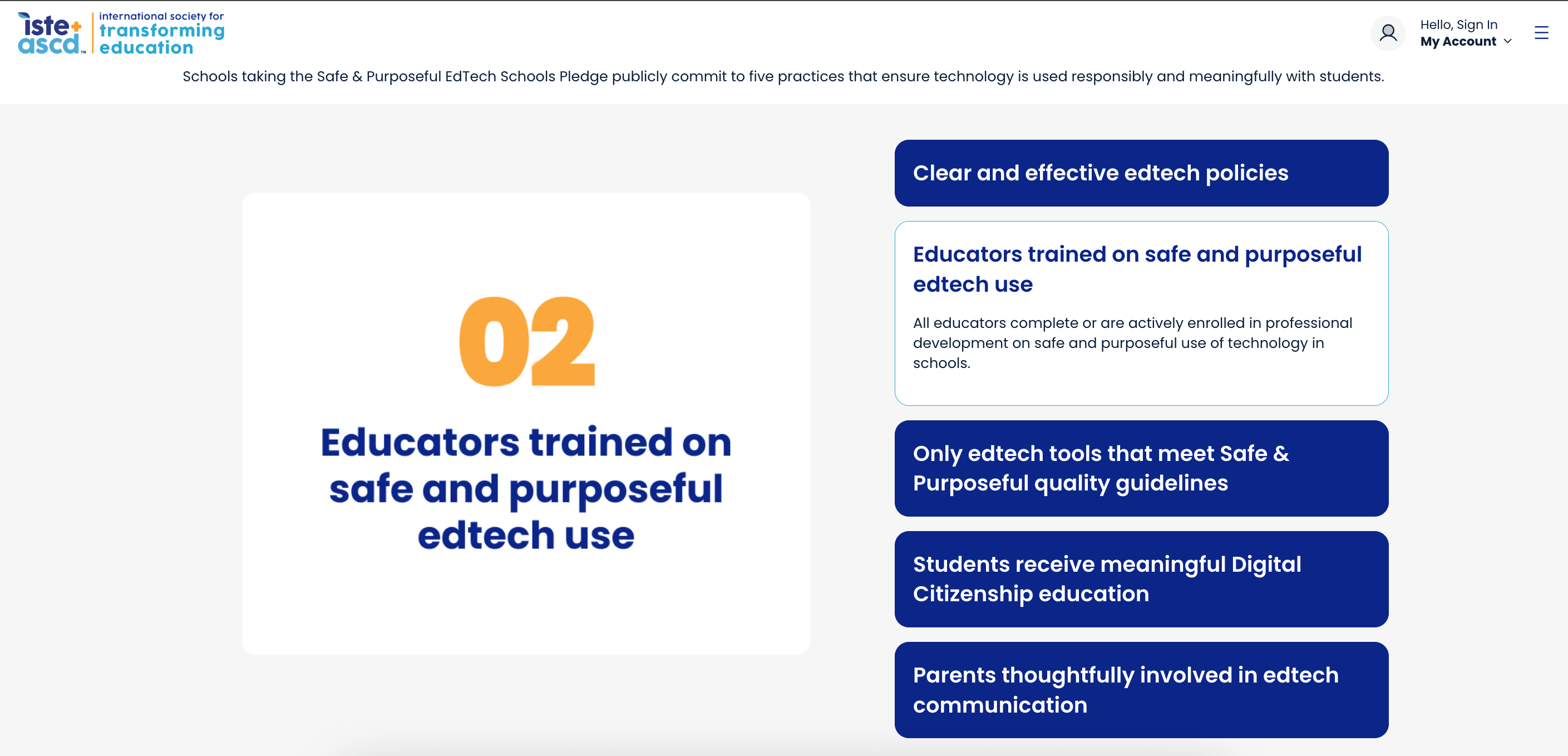
Pillar two, training, is about the teacher, not the tool. It covers whether a teacher exercises good judgment while using a given technology, regardless of which technology it is. A well-vetted, perfectly safe tool can still be used unsafely if, for example, a teacher pastes in more student data than a task needs, treats an automated flag as a final verdict instead of one signal worth checking, leaves a sharing setting more open than it needs to be, or skips verifying AI-generated content before it reaches students. These are not issues with the tools, per se. These are problems that can arise when tools are not used correctly. That is what professional development can actually change.
Pillar three, tool procurement, is about the tool itself, and covers whether the technology a school puts in front of students was safe to begin with, before any teacher ever touched it. I will get to that pillar in Part 4. For now, the distinction is worth holding onto: procurement exists to keep unsafe tools out of the building, and training exists to keep safe tools from being used unsafely once they are inside it.
Why this matters
Technology professional development tends to get treated as something reactive by nature. A new tool gets approved, and a session gets scheduled to introduce it. A new policy gets written, and a session gets scheduled to explain it. There is always something new to respond to, which makes it easy for an organization to mistake “we held a session about the new thing” for “our educators are trained.” But professional development cannot only be reactive if we are striving for relevant, holistic learning for educators.
Good professional development lays a foundation strong enough that a teacher can exercise sound judgment regarding a tool that has not been invented yet, not just the one that was covered in last month’s session. There are foundational concepts like purposeful use, alignment to learning goals, student data privacy that will always apply. Furthermore, none of us entered the classroom an expert in educational technology, and the ones who have become experts are usually the first to admit how much they still have left to learn, particularly as the pace of change keeps accelerating.
What makes this harder than it sounds
There are really two different traps hiding inside this one pillar.
Unsafe uses. These are the practices that put students at risk regardless of intent. A teacher pasting student writing or behavioral notes into a general-purpose AI tool, without knowing what happens to that data once it is submitted, is one example. A teacher adopting a tool independently, outside the school’s approved list, is another. Overreliance on AI detection or monitoring software, treating a flag as a verdict instead of a starting point for a conversation, is a third. I want to point out that none of these risks are inherent to the tool. Rather, these are risky practices that should be addressed and avoided.
Unpurposeful uses. These are admittedly lower stakes than the unsafe category, but they are far more common. I don’t mean to say that unpurposeful use of tech comes from a bad or negligent place, they rarely do. Rather, I believe the unpurposeful use of technology comes from half-truths, ideas true enough to feel safe repeating, that quietly justify decisions no one would actually defend if they said the whole sentence out loud.
Here are a few half-truths of EdTech.
Data. It is true that technology can collect student responses efficiently. It is a lie that collecting the data is itself the benefit. If a teacher never actually uses what was collected to adjust instruction, the advantage technology offered was never realized in the first place.
Additive. It is true that technology is a resource. It is a lie that a resource being available, expected, convenient, or popular is itself a reason to use it.
Transformative. It is true that technology can amplify and transform a learning activity. It is a lie that it always does. Sometimes a tool replaces a simpler alternative without adding enough value to justify the switch. Sometimes the final product looks polished while the thinking underneath it stays thin.
Engagement. It is true that technology can deepen a student’s engagement with a topic. It is a lie that engagement is the same thing as learning. A student can be drawn in by cheap engagement, the pull of gamification, points, and streaks, while a teacher mistakes that pull for thinking. The student is engaged, or busy, but not necessarily doing the thinking the lesson intended.
If I were leading a workshop
I would call it “Would You DATE This Lesson?,” making an acronym out of the list above (I love a good acronym). Before a use of EdTech passes, it has to hold up against all four letters: does it produce usable Data a teacher will act on, is it Additive rather than adopted just because it is available, is it genuinely Transformative rather than a polished version of something simpler, and does it produce real Engagement with the thinking, not just with the activity.
Practically speaking, I would hand participants a set of lesson descriptions, written up like dating profiles, complete with an appealing headline and a few details that only show up once you read past it. In small groups, participants would sort each one: swipe right if it clearly passes DATE, swipe left if it should be scrapped for a simpler approach, and “it’s not you, it’s me” for the ones that are close but need revision before they are ready. The debrief question that matters most is not which category a lesson landed in, but which specific letter it failed, since that turns the test into something participants can reuse on their own the next time a new tool shows up in their inbox.
An invitation
What does professional development on the safe and purposeful use of edtech actually look like at your school right now? Is it reactive, a session scheduled every time something new is approved, or does it build a foundation teachers can apply to tools that have not been invented yet? And when something does go wrong, a flagged student, an oversharing incident, a tool adopted outside the approved list, do your teachers already know how to spot the red flag themselves, or is someone else catching it for them after the fact? I would like to hear where your school actually stands.
I will see you next Tuesday for Part 4, on purchasing edtech that meets quality and safety standards.