

Only EdTech Tools That Meet Safe & Purposeful Quality Guidelines
Why Approval Is Harder Than It Looks

Part 4 of 6 in a series on the Safe & Purposeful EdTech Pledge. Check out Part 1, Part 2, and Part 3.
I am often asked which AI tool a school should purchase.
“Lewis, how does MagicSchool compare to Gemini?”
“What do you think about Flint? Is it similar to SchoolAI?”
Principals, technology directors, and superintendents are weighing the pros and cons of various EdTech tools, and there is simply a lot to keep in mind while doing so.
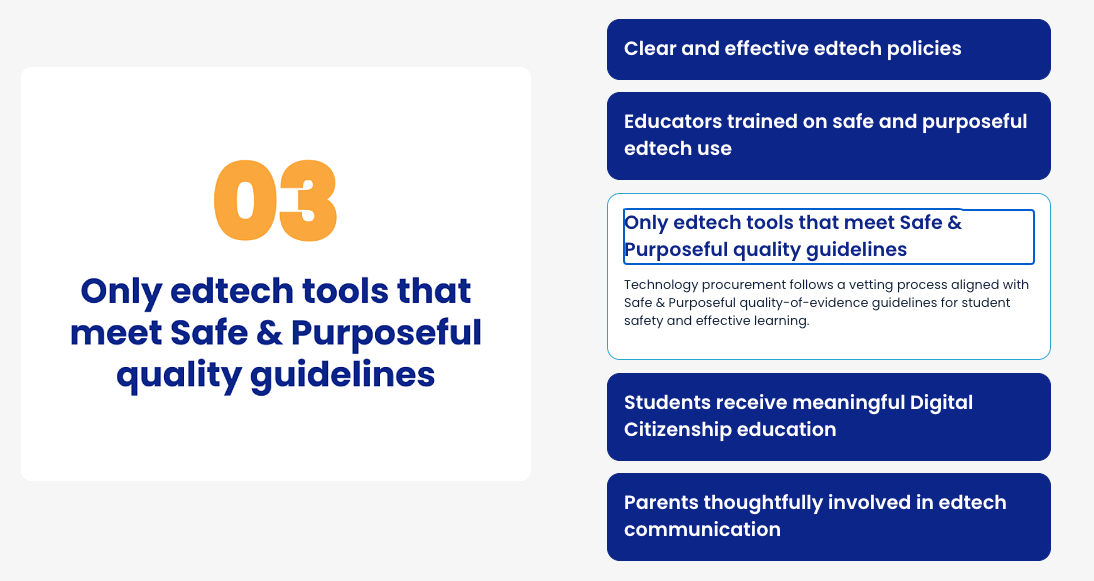
The third commitment in ISTE’s Safe & Purposeful EdTech Pledge points leaders in the right direction. ISTE urges learning organizations to follow a vetting process “aligned with Safe & Purposeful quality-of-evidence guidelines for student safety and effective learning.”
Let’s talk about why that’s important and what leaders can do about it.
Why this matters
At a high level, a tool approval process exists for two primary functions: student safety and evidence it will improve learning (or at least a credible promise that it will). While those functions aren’t necessarily the reasons that come up first in most conversations about vetting (“Is it free?” probably takes the cake on that one), they speak to our core mandates as educators are to keep students safe while entrusted to our care and to guide them along their academic journey.
However, the conversation about tool approval can’t end there. There are downstream reasons tool approval processes matters too. A real approval process also builds buy-in for a broader initiative, since a tool that has visibly gone through scrutiny lands differently with a staff than one that simply appeared. And it gives educators a genuine sense of permission. A teacher who knows a tool has been vetted can use it with confidence, rather than wondering whether they are taking on risk by adopting something no one has actually reviewed.
Idyllic Aldi
There’s a why reason shopping at Aldi is unique. In a world with so much choice, decision paralysis reigns, and Aldi intentionally limits the number of product choices we have to make.
If only EdTech were the same way.
What makes tool approval hard is that in the face of so many options, there is a real temptation to avoid picking at all. Especially regarding tools that support teachers in delivering the curriculum. Many promise roughly the same set of capabilities, so distinguishing meaningfully between them starts to feel like splitting hairs.
Some schools go down an easier path of letting individual educators find and use what works for them, treating tool selection as a matter of personal preference rather than institutional responsibility. That instinct is understandable, and it even sounds respectful of teacher autonomy. But it is also how a school ends up with the exact problem this pillar exists to prevent, a building full of unapproved tools that were never actually compared against one another, adopted one classroom at a time because picking felt harder than not picking.
This isn’t easy, particularly in the AI era as schools feel a need to move quickly enough to respond to how fast the EdTech landscape is changing, while still being intentional enough that a tool is aligned to a strong purpose.
Resources for tool approval
Two existing resources are worth knowing about here, even though neither is mine, and I do think these are valuable.
ISTE’s Teacher-Ready Tool Certification checklist is a reasonable starting point. The checklist is far from perfect. Building a truly comprehensive checklist like this is difficult…trust me, I have tried something similar it myself! But, I believe that walking through this one is still valuable, mostly for the conversations and questions it surfaces along the way.
The EdTech Index is a repository of tools reviewed against a shared set of validations: whether a tool is safe, evidence-based, inclusive, usable, and interoperable. For a school without the capacity to build its own review process, checking whether a tool already appears in this index is a fast way to inherit someone else’s vetting rather than starting from nothing.
If I were leading a workshop
From my work with both in-service teachers, administrators, and teachers in formation, I know how fun it is to open the Pandora’s box of EdTech tools.
The temptation with any conversation about tools it to let the surface level features drive the conversation. Instead, you have to ground it in purpose.
I would start by grouping participants by the type of tool they are actually investigating, since a group comparing several AI writing assistants will have a different conversation than one comparing tutoring platforms or classroom management tools.
Before anyone looks at a specific product, each group would norm on what its indicators, its actual look-fors, mean in practice: what does “safe” really look like for a writing assistant specifically, what would count as real evidence of learning impact for a tutoring tool. Only once a group has agreed on what they are looking for would they turn to the tools in front of them and evaluate each one against those shared indicators.
Then I’d have each group discuss what they noticed once they applied the framework, and why those particular insights mattered enough to change how they were thinking about the decision.
That conversation is what gets a room out of decision paralysis, since the paralysis usually comes from treating every tool as a completely unique judgment call. Once a group has normed on what they are actually looking for together, comparing similar tools stops feeling like splitting hairs and starts feeling like a straightforward comparison against a standard they built as a group.
An invitation
Pick one tool your school is currently using, or seriously considering, that has never gone through a real evaluation. Before your next leadership meeting, complete one for it, using either of the resources above or your own school’s process if you already have one.
I will see you next Tuesday for Part 5, on digital citizenship education for students.